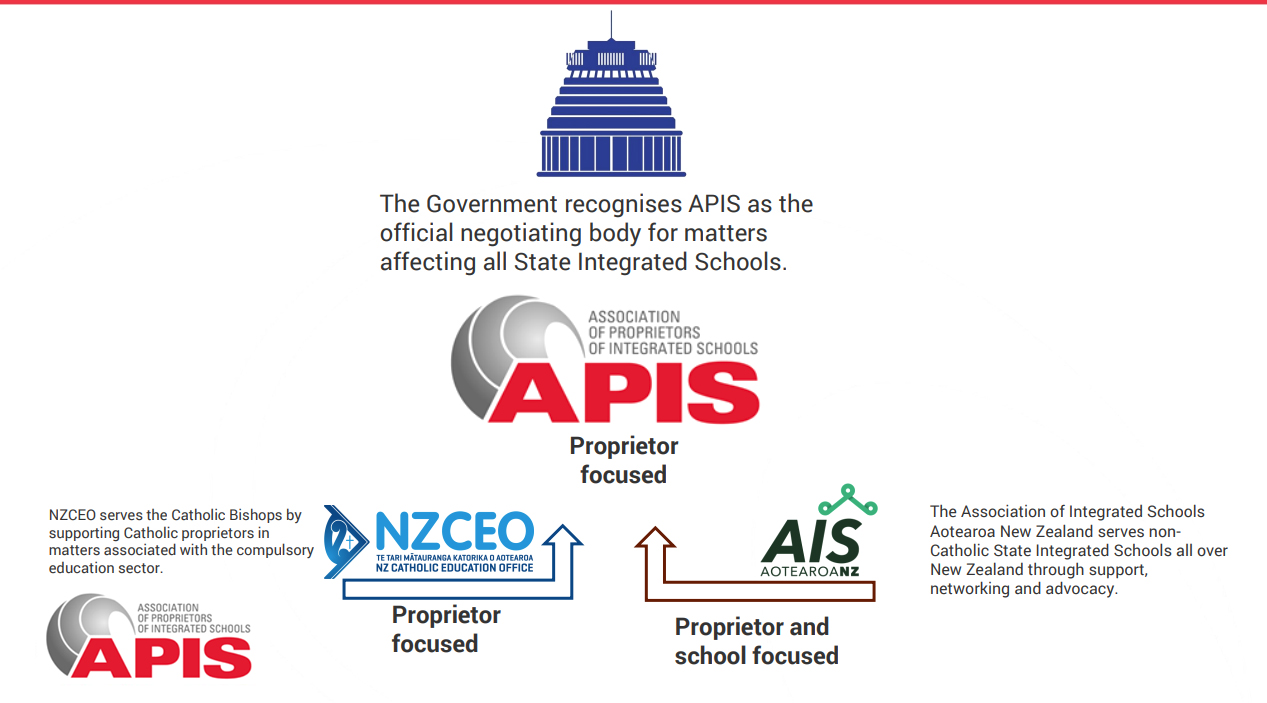
Ever wondered what the role of the Association of Proprietors of Integrated Schools (APIS) is? The office is often asked to explain what APIS does and how NZCEO and AIS fit into the overall state integrated sector. This presentation explains the collaborative framework that APIS works within, and also provides information on funding streams for the state integrated sector.
APIS plays a central role in New Zealand’s unique state integrated school system. Established to represent the proprietors of all state integrated schools—both Catholic and non-Catholic—APIS acts as the sector’s official voice in negotiations with the government. Its primary function is to advocate for the collective interests of integrated schools, ensuring their needs and perspectives are considered in national education policy and funding decisions.
State integrated schools are part of the public education system but retain a “special character,” often religious or philosophical, which is protected by law. These schools were originally private institutions that chose to integrate into the state system under the Private Schools Conditional Integration Act 1975. While they receive government funding for operations and staffing, the land and buildings remain privately owned by the proprietors, who are responsible for maintaining the school’s special character.
APIS unites these diverse proprietors under one umbrella, fostering collaboration and shared advocacy. It provides a platform for addressing common challenges, such as property funding, legislative changes, and maintaining the integrity of special character education. APIS also facilitates communication between schools and government agencies, ensuring that integrated schools are well-represented in policy discussions.
The New Zealand Catholic Education Office (NZCEO) plays a vital role within APIS. Constitutionally mandated as the Executive Secretariat of APIS, NZCEO acts as its agent, office, and secretariat. This means NZCEO not only supports Catholic integrated schools but also provides expert advice and administrative support to APIS as a whole. NZCEO’s leadership ensures that Catholic schools—by far the largest group of integrated schools—are actively involved in shaping the direction of the sector.
On the other hand, the Association of Integrated Schools (AIS) serves the non-Catholic integrated school boards and proprietors. While NZCEO focuses on Catholic schools, AIS focus on the voices of other integrated schools. Together, APIS, NZCEO, and AIS form a collaborative framework that strengthens the state integrated sector. APIS provides the overarching representation, ensuring integrated schools maintain their unique identities while benefiting from the stability and support of the state education system.
In summary, APIS is the cornerstone of integrated school advocacy in New Zealand. It ensures that the diverse voices within the sector are unified and effectively represented.